

Article: She Built the Table
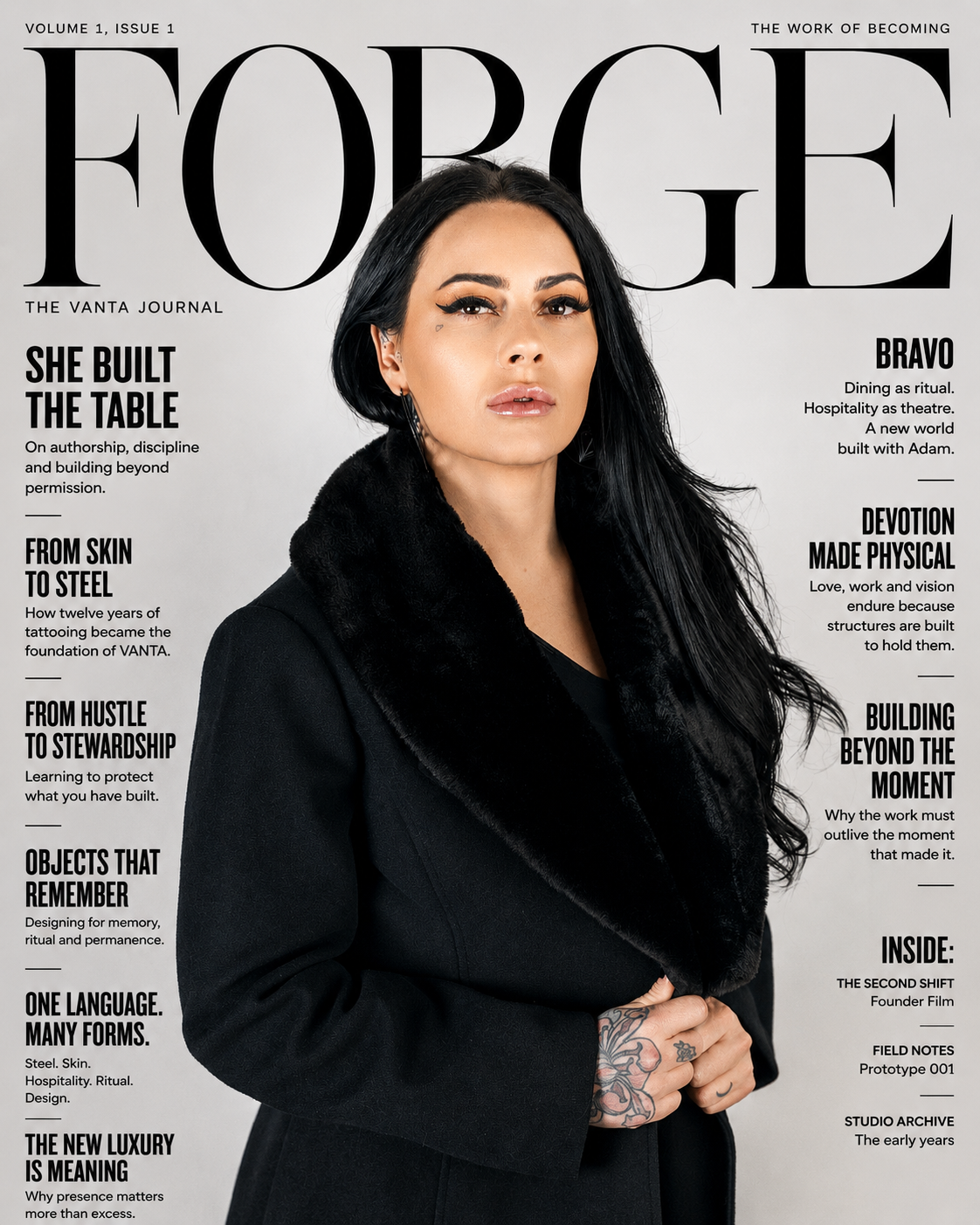
She Built the Table
She Built the Table
The first packaging arrives next week.

Five years ago, I didn’t know packaging could matter. Today I’m choosing the weight of the paper that will carry a Founder Letter, deciding whether the Certificate of Authenticity should be brushed or polished stainless steel, and refining the provenance coin that will welcome the first sixty collectors into the Steel Circle.
On the table in front of me are prototype forks and spoons that have become part of everyday life. We eat with them every night, and when friends visit, they eat with them too — I watch them instinctively lift the fork, turn the spoon in their hands, test the balance without realising they’re doing it. The knife still isn’t serrated. We joke about it every dinner.

Around them are the traces of five years: drafts of collector agreements, care guides waiting to be printed, packaging samples, material swatches, night school notes from BRAVO, camera gear packed for another documentary, sketches for future collections, 3D printed provenance boxes, bookmarks from HARVEST, a notebook full of questions that didn’t exist when this project began.
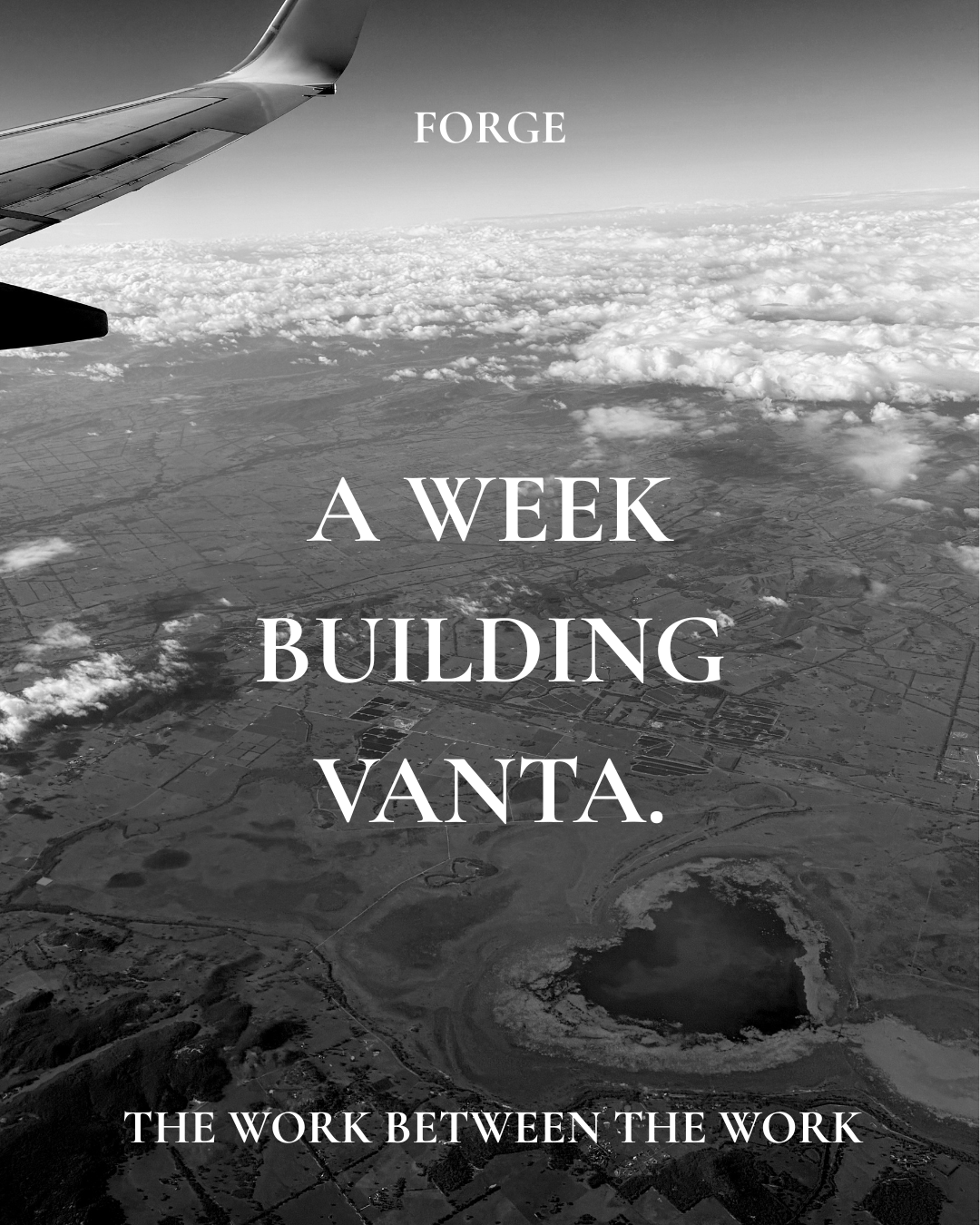
Tomorrow I’ll board a flight to Canberra. Not for TABLE. For a coin.
Five years ago I didn’t know what provenance meant. I didn’t know how cutlery was manufactured, what a tooling tolerance was, or why balance mattered. I didn’t know how to read a manufacturing quotation. I certainly didn’t imagine I would one day care about the finish of a certificate, the thickness of a rigid presentation box, or the way a collector unfolds a letter for the first time.
I thought I was designing cutlery. Looking back, I was learning how to build a design practice.
Every prototype taught me something the last one couldn’t. Every delay revealed another assumption. Every setback introduced the next collaborator. Every year removed another unnecessary decision.
The objects became quieter. So did I.
This essay isn’t the story of a cutlery collection. It’s the story of what happened while I was trying to make one.

The Line That Refused to Leave
Every project has a beginning. This one arrived quietly.
There was no grand plan to build a cutlery collection — no market research, no business model, no understanding of manufacturing, tooling or production. I wasn’t searching for a new direction. I was simply following the momentum that had begun with VANTA.
I was living in a small apartment in Brunswick. My first architectural panels had arrived only a few months earlier, and they were unlike anything I had made before. Until then, my drawings had lived on skin, paper and screens. Now they had weight. They cast shadows. They occupied space. Holding them in my hands changed the way I thought about drawing.

The question was no longer, What can I draw? It became, What else can a line become?
That question spread into everything: bookends, candlesticks, lighting, furniture, architectural details, small objects — anything that could carry the same language of line into another part of everyday life. Looking back, I realise I had stopped thinking like a tattoo artist. I had started thinking in objects.
I printed drawings onto sheets of paper, cut them apart with scissors and taped them back together to explain impossible folds to manufacturers. I had no idea how sheet metal behaved, no understanding of bend allowances or fabrication — I was inventing my own language because I didn’t yet know the industry’s. Most of it made no sense. But every terrible mock-up was an attempt to bridge the gap between the image in my mind and the people capable of making it.
One evening I opened my iPad. I wasn’t trying to design cutlery. I wasn’t studying historical flatware or analysing ergonomics. I simply started drawing.
The silhouettes arrived almost immediately. They felt strangely familiar, as though I was remembering them rather than inventing them. The fork, the knife and the spoon appeared with the same flowing symmetry that had already begun shaping the rest of my work. I never questioned them. I just kept drawing.
 Five years later, almost every dimension has changed. The curves have softened, the balance has shifted, edges have been refined by fractions of a millimetre, every transition reconsidered, every surface tested. Yet when I place the first drawing beside the production prototype, the relationship is unmistakable. The essence has never changed. The line knew where it wanted to go long before I understood how to get it there.
At the time, I thought I was sketching a small collection of objects to sell at tattoo conventions. I’d already produced bookmarks, keyrings and small metal pieces, and a boxed cutlery set didn’t seem that different — something that could sit on a table beside my books, something people could take home, something beautiful, something that carried the same language as the rest of VANTA. I thought it would be straightforward.
I created a rough request for quotation with awkward mock-ups, basic dimensions and packaging concepts that, looking back now, make me laugh. I sent it into the world with complete confidence, unaware of how much I didn’t know.
Sometimes ignorance is generous. If I’d understood everything that project would ask of me, I might never have begun. Instead, I was given something much better: permission to learn.
I thought I was drawing a fork. What I had really begun drawing was the outline of the next five years of my life.

The Depth Beneath the Object
I can’t tell you there was a single moment when I realised I had no idea what I was doing. It wasn’t like that — the understanding arrived gradually. Every answer uncovered another question.
The first request for quotation came back. Then another. Suddenly I wasn’t looking at drawings anymore. I was looking at tooling, minimum order quantities, packaging dimensions, shipping cartons, lead times, surface finishes, material grades, testing, certification. One question became ten. Ten became one hundred. The deeper I travelled into the project, the more I understood how much remained beneath the surface. The silhouettes had taken one evening. Learning how to honour them would take years.
When the first laser-cut prototypes arrived, I was excited. Holding the drawing in steel felt extraordinary — for the first time, I could turn it over in my hands instead of imagining it on a screen. It was proof that the idea could exist. It was also proof that it wasn’t finished.
The proportions felt wrong. The weight was wrong. The balance was wrong. The knife could never simply be laser cut from flat steel — it needed volume. The spoon needed depth. The fork needed stiffness. The object wasn’t asking to be manufactured. It was asking to be understood.
That realisation changed everything. Until then I thought design ended with the drawing. Instead, I discovered the drawing was simply the beginning of a conversation. Every manufacturer saw something different. Every engineer asked questions I couldn’t answer. Every prototype exposed another assumption.

Slowly, I stopped searching for confirmation. I started searching for understanding. The project became less about making cutlery and more about an education: manufacturing taught me patience, engineering taught me precision, packaging taught me experience, provenance taught me legacy, suppliers taught me discernment, collectors taught me responsibility. The object kept asking more of me.
Every year I thought I was getting closer to finishing. Looking back, I was simply becoming capable of asking better questions. That’s what depth really is — not complexity, but curiosity. The willingness to keep following a question long after the first answer appears.
Five years later, I still don’t feel like I’ve reached the bottom. I don’t think I ever will. And perhaps that’s the gift, because every layer uncovered has made the work quieter, more considered, more honest. The object has become simpler only because I became more willing to explore its complexity.

The Cost of Believing
Every project reaches a point where belief is tested. For me, it wasn’t the long nights or the endless revisions — it was learning that determination alone isn’t enough.
By 2025, my focus had begun to drift. TABLE was still there, always waiting, but my attention had expanded into a much larger dining collection — serving pieces, new objects, an entire ecosystem imagined around the table. Like so many moments in this project, my ambition had moved ahead of my experience.
At the same time, I was stepping away from the certainty of tattooing to give VANTA the attention it deserved. Tattooing had given me stability; VANTA offered no such promises. Every decision carried risk. Every dollar had a purpose before it had somewhere to go.
Then life intervened. My car was written off, and the insurance payout arrived at exactly the moment I was wondering how I would fund the next stage of the work. At the time, it felt like an answer. Looking back, it was another question.
I invested everything into the dining collection. I believed I had found the right supplier — the conversations were convincing, the promises felt genuine, and I wanted it to work badly enough that I overlooked the questions I should have been asking. Then they disappeared. The money disappeared. The supplier disappeared. The work stopped.
For a while, I carried the weight of that decision, thinking that if I had invested the money into TABLE instead, perhaps the collection would already exist — perhaps I had chosen the wrong path. Time has a way of softening certainty. Looking back now, I no longer see that experience as a detour. I see it as an education. The project wasn’t teaching me how to manufacture objects. It was teaching me discernment: how to recognise integrity, how to ask uncomfortable questions, how to read contracts instead of promises, how to understand that trust is built slowly, then tested all at once. Most importantly, it taught me that urgency rarely produces enduring work. I had been trying to force the next chapter before I had fully understood the one I was already in. The work had other plans.
Looking back, I can see something I couldn’t recognise at the time. If that supplier hadn’t disappeared, I may never have reached out one final time. I may never have asked for help. I may never have met Karyl. Some chapters only make sense once you’ve already left them.
At the time, it felt like losing momentum. Now it feels like the project quietly correcting my direction. The path was never straight. It wasn’t supposed to be — every wrong turn carried me closer to the people who would eventually help bring the work to life. Sometimes the work protects itself. Sometimes it refuses to be rushed. Sometimes it simply waits until you’re ready to build it properly.
I don’t regret losing the money. I regret believing that progress could be hurried. The object deserved more patience than I was giving it. Perhaps I did too.

The People Who Find You
For a long time, I believed I had to solve everything myself. Every problem felt like another skill I needed to learn — manufacturing, engineering, packaging, marketing, photography, contracts, freight, retail, branding. If I didn’t understand something, I assumed the answer was to work harder. The project kept teaching me something different: some problems aren’t solved alone. They’re solved by finding people who care about the work as deeply as you do.
By the end of 2025, I had reached another crossroads. Years had passed. The drawings were there. The prototypes were there. The ambition hadn’t changed. What I needed was someone who could see through the noise of hundreds of files, failed experiments and unfinished ideas, and recognise the object hiding underneath.
So I asked for help one last time. I wrote a post on Instagram — not because I wanted attention, but because I refused to let the project disappear unfinished. A mutual friend introduced me to Karyl. At the time, it felt like another conversation. Looking back, it became one of the defining moments of the project.
I arrived carrying years of work: laser-cut prototypes, early CAD models, photographs, packaging concepts, drawings, measurements, reference cutlery that Adam and I had collected over the years — thousands of decisions scattered across folders, notebooks and memory. It was a mess, five years of trying to teach myself an industry I had never belonged to. I expected another long process of explanation.
Instead, something unexpected happened. He understood it, almost immediately — not just the geometry, but the intention, the restraint, the reason the object existed in the first place. For the first time, I wasn’t asking someone to manufacture a drawing. I was working with someone who could read it.
That changed everything. The conversations became quieter, more precise. We weren’t debating what the object should become — we were refining what it already was. Weeks became months. Models evolved. Dimensions shifted by fractions of a millimetre. Every adjustment made the work feel calmer, more resolved.
Then one day, the prototypes arrived. I still remember opening the box. I smiled before I picked them up. Then I cried — not because they were finished, but because after five years, I finally recognised them. They felt exactly as I had imagined all those years earlier, sitting on a couch in Brunswick, drawing silhouettes I couldn’t yet explain.
That evening, Adam and I ate dinner with them for the first time. Nothing ceremonial. Just dinner. Since then, every guest who visits our home eats with those same prototypes. I watch them without saying anything. Someone always turns the fork over in their hand. Someone always feels the weight of the spoon. Someone always reaches for the knife. The knife still isn’t serrated. We laugh about it every time.
Those quiet moments tell me more than any survey or focus group ever could. People instinctively understand the object. Watching them has become part of the design process. The object leaves my hands for a moment, then returns carrying another lesson.
Looking back, I realise Karyl didn’t simply help manufacture TABLE. He helped restore my trust in collaboration. The project had spent years teaching me how to ask better questions. Now it was teaching me something equally important: the right collaborator doesn’t take ownership of the work. They create the conditions for it to become fully itself.
That lesson reaches far beyond TABLE. It has shaped every commission since, every exhibition, every conversation with an architect, every future project. No meaningful practice is built alone. Every object carries the fingerprints of the people who quietly believed in it long before anyone else could see what it might become.

When the Object Stops Asking
I’ve lived with these prototypes for more than six months now. That might not sound remarkable. For me, it is.
Every project I’ve ever made has carried a quiet itch — a corner to soften, a proportion to revisit, a line to redraw, an idea to push just a little further. Design becomes a conversation that rarely ends. These are different.
For six months, they’ve sat on our dining table through breakfast, lunch, dinner, quiet nights and celebrations. Friends have joined us around the table and, without any instruction, begun interacting with the objects exactly as I’d hoped they would. Someone always reaches for the spoon before serving. Someone balances the fork between their fingers. Someone instinctively tests the weight of the knife. The knife still isn’t serrated. We smile every time someone pretends it is.
Those small moments tell me more than any design review ever could. The objects have stopped being prototypes. They’ve become part of the ritual. That was always the ambition — not to create something people admire from a distance, but something people reach for without thinking. The greatest compliment a designer can receive isn’t praise. It’s habit.
Watching people use TABLE has taught me something I wasn’t expecting: design doesn’t end when the object leaves the workshop. It begins again when it enters someone’s life. Every meal becomes another conversation. Every gathering becomes another review. Every shared table becomes another opportunity to observe how an object quietly participates in a ritual that has existed for thousands of years.
That responsibility feels different now. I’m no longer asking whether the fork is beautiful. I’m asking whether it disappears into the experience of gathering — whether the weight feels natural, whether the spoon encourages someone to slow down, whether the object quietly earns its place among the rituals of everyday life.
For years, I believed refinement meant adding knowledge. Now I think it means removing uncertainty. For the first time since those silhouettes appeared in Brunswick, I haven’t wanted to change the design — not because it is perfect, nothing ever is, but because the conversation between the object and me has become quiet. We’ve arrived at an understanding.
That feeling is difficult to describe. After five years of questioning every curve, every edge, every proportion and every decision, silence feels unfamiliar. Comfortable. Earned.
The work has finally stopped asking me who it wants to become. Now it’s asking something much more important: who will it belong to? That question changes everything, because the next chapter isn’t about design. It’s about trust.
Soon these objects will leave my table and become part of someone else’s. Someone will unwrap the presentation box, read the Founder Letter, hold the provenance coin, run their fingers across the stainless steel Certificate of Authenticity. Then they’ll set the table — perhaps for family, perhaps for friends, perhaps for someone they’ll remember for the rest of their life. From that moment onwards, the work is no longer mine. It becomes part of their story.
I think that’s what I’ve been making all along. Not cutlery. A place for memories to gather.

The Steward
The work has changed. So has my role within it.
For five years, every decision revolved around making the object — every drawing, every prototype, every conversation with a manufacturer, every setback, every refinement, all of it pointing towards this moment. Now the object is ready. I am the one catching up.
For the first time, my days are no longer filled with redesigning a fork or adjusting the curve of a spoon. Instead, I’m writing Founder Letters, choosing the paper that will carry them, selecting the finish of a stainless steel Certificate of Authenticity, refining a provenance coin that will welcome the first sixty collectors into what I’ve come to call the Steel Circle. The object hasn’t become less important. Its world has simply become larger.
I’ve realised that designing doesn’t stop when fabrication ends. It extends into every moment that follows — the weight of the presentation box, the resistance of a magnetic lid as it opens, the first page of a care guide, the feeling of unfolding a letter written by hand, the quiet pause before someone lifts the first piece from its place. These moments are all part of the work. They’re all part of the same line.

For a long time, I thought design finished when the object was complete. Now I understand that completion is where another discipline begins: stewardship. Looking after the work. Protecting its intention. Finding the people who will understand it — not simply the people who can afford it, but the people who will live with it, celebrate with it, gather around it, and quietly reach for it every evening until, years from now, it no longer feels like an object they purchased. It simply feels like part of their lives.
That thought changes every decision I make. I’m no longer asking how many sets I can sell. I’m asking where they belong — which tables, which homes, which restaurants, which conversations, which memories. The first sixty collectors are helping begin something much larger than a product launch. They’re becoming custodians of the first chapter. Long after the Founding Collector Edition has found its homes, those objects will continue carrying the story of how VANTA began. That responsibility feels immense. It also feels deeply personal.
As I write this, my dining table has disappeared beneath the project — prototype cutlery beside 3D printed provenance boxes, draft Founder Letters beneath packaging samples, material swatches, collector agreements, retail terms, care guides, photography shot lists, camera batteries charging for the next documentary, hard drives filled with years of sketches, a notebook full of ideas that will become tomorrow’s work.
Tomorrow, I’ll fly to Canberra. I’m going to learn how coins are made. Five years ago, I wouldn’t have understood why that mattered. Today, I understand that every detail carries meaning — not because it adds luxury, but because it adds care. The work has taught me to look deeper, to slow down, to ask one more question before making another decision. Perhaps that’s what stewardship really is: not protecting an object, but protecting the intention that brought it into the world.
The irony isn’t lost on me. I began this project believing I was making a beautiful set of cutlery. Somewhere along the way, the object quietly began making me. It taught me patience when I wanted speed, discernment when I wanted certainty, collaboration when I believed I had to carry everything alone. It taught me that the things we hope will endure deserve time.
Now another lesson begins — not how to make the work, but how to let it go. To trust that the people who choose to live with these objects will continue writing the story in ways I never could. That has always been the purpose: not to place more objects into the world, but to create something worthy of becoming part of another person’s life.

The Table
The more time I spent designing TABLE, the less I found myself thinking about cutlery. I began thinking about people — about the places we return to throughout our lives, the rituals we rarely notice while we’re living them. The table has always been one of those places.
Long before I ever drew a silhouette, it had already witnessed birthdays, weddings, quiet Tuesday dinners, difficult conversations, celebrations, grief, laughter and reconciliation. It has always been where life unfolds, one meal at a time. It asks very little of us. Only that we arrive.

That simplicity is what drew me back, again and again. For years I believed I was refining the weight of a fork. Looking back, I was asking a different question: how can an object quietly belong to one of the most important rituals in our lives? The answer was never found in decoration, complexity or novelty. It was found in attention — attention to proportion, to weight, to touch, to the small moments that become invisible once an object begins to feel familiar.
The best objects don’t ask to be admired every day. They ask to be lived with, to become so naturally woven into a person’s life that they disappear into the ritual itself. I think that’s what I’ve been searching for all along — not permanence through material, but permanence through memory.
A fork is held for only a few moments. Those moments are repeated thousands of times across a lifetime: a child learning to eat, friends staying long after dinner is finished, parents growing older, a celebration that becomes a tradition, a farewell no one knew would be the last. The object witnesses them all, quietly, without asking for attention, without asking to be remembered.
Perhaps that is why I cared so deeply about every detail — not because perfection exists, but because these objects would eventually leave my hands. They would belong to someone else’s story.
For years I’ve described TABLE as Sculpture for Dining. I still believe that. Today I’d add something else: it is architecture at the scale of the hand. Architecture isn’t simply about buildings. It’s about shaping the spaces where life unfolds, and the table is one of humanity’s oldest pieces of architecture. Everything surrounding it deserves the same care.
If these objects endure for generations, I hope they aren’t remembered because they were beautiful. I hope they’re remembered because they became part of someone’s life — because they carried birthdays, anniversaries, conversations, silence, because they quietly witnessed a family’s history without ever asking to become the centre of it.
Perhaps that’s what good design has always done. It doesn’t interrupt life. It gives life somewhere to happen.

The House I Didn’t Know I Was Building
When I drew those first silhouettes in my Brunswick apartment, I thought I was designing a small collection of objects. I imagined a boutique homewares brand — a few beautiful pieces, something I could take to tattoo conventions alongside my books and prints. The vision felt ambitious enough. I couldn’t see beyond it.
Five years later, I realise the cutlery was never the destination. It was the education. Every supplier taught me something. Every failed prototype removed another assumption. Every setback sharpened my judgement. Every collaborator expanded the work. Every conversation changed the questions I was asking. The object became quieter because I became quieter. The work became clearer because my thinking became clearer.
TABLE taught me how to manufacture. It taught me how to collaborate, how to listen, how to trust time instead of resisting it. It taught me that restraint isn’t the absence of ideas — it’s the confidence to leave only the right ones behind. Most of all, it taught me that meaningful work isn’t measured by how quickly it arrives. It’s measured by how deeply you’re willing to understand it.

As I write this, the first packaging is almost here. The provenance boxes are in production. The collector coins are being minted. Founder Letters wait to be signed. The first sixty collections are preparing to leave my table and find their way onto sixty others. Soon, these objects won’t belong to me. They’ll belong to the people who gather around them. That’s exactly as it should be.
Five years ago, I believed I was making cutlery. Today, I know I was building something much larger — not simply a collection, not simply a business, but a design practice, a publishing house, an exhibition practice, a body of films, a way of thinking, a language built through line, material and memory.
What began with a single silhouette has become VANTA. The line is still leading. I’m simply learning how to follow it.

The inaugural Founding Collector Edition is limited to 60 individually numbered collections.
Eight place settings · Stainless steel Certificate of Authenticity · Provenance coin · Hand-signed Founder Letter · Collector Guide · Lifetime Manufacturing Warranty · Presentation case
Reserve Your EditionThe line is still leading. I’m simply learning how to follow it.

Written by Breanna Lanyon

Leave a comment
This site is protected by hCaptcha and the hCaptcha Privacy Policy and Terms of Service apply.