

Article: The Work Between the Work
The Work Between the Work
THE WORK BETWEEN THE WORK
Volume One · Essay One
July 2026
Most of the work that matters never happens in the studio.
It happens in airport lounges and across dinner tables. In the quiet ambience of a gallery, in a question from a stranger that you can't answer. It rarely looks like work, yet it is the part that changes everything made afterwards.
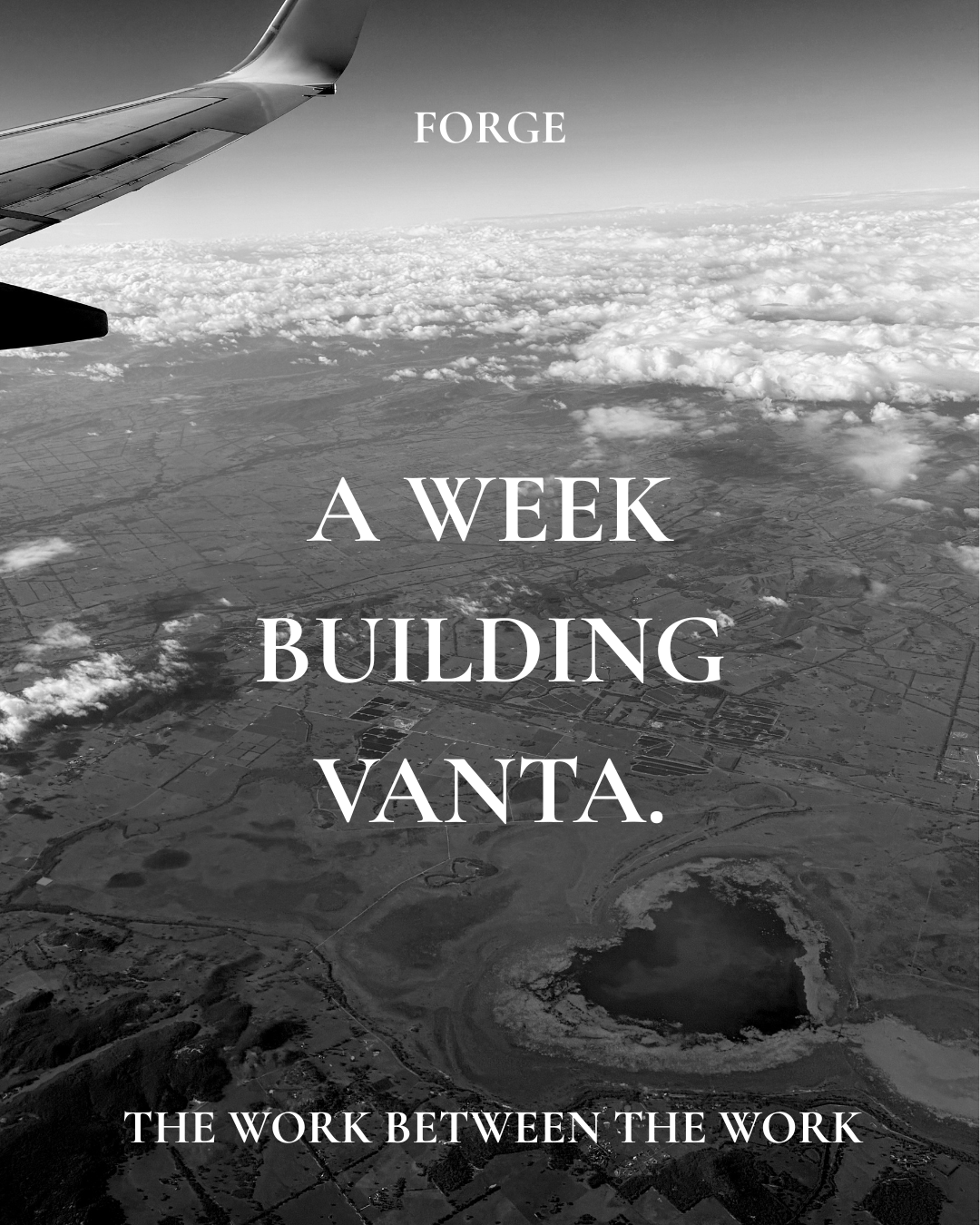
Last week I travelled from Brisbane up into the Blue Mountains, through the Hunter Valley and Sydney, and home again to Melbourne. On the calendar it read as a week of meetings. In practice it was closer to an education. Every room sharpened the work and every landscape encountered left a mark on it. By the time I got home I was fairly sure of something I'd long suspected, that the objects I make begin long before I draw them.

I. The Right Questions
When I first began showing VANTA to architects and designers, I assumed they were coming to look. They came instead with questions, and most of them were questions I couldn't yet answer. Which grade of stainless — 304 or 316? Could the work be specified for a coastal site? What was the lead time, the food-safety rating, the durability of the PVD? Who engineered it, who installed it, against which standards? Every question opened a gap in what I knew.
At first that was unnerving. It felt like being found out. It took me a while to understand it was a gift. The people asking weren't testing me; they were refining the work. A good client doesn't only buy the piece; they make it better by expecting more of it.
So I stopped trying to appear to know everything. Now when a question lands beyond me, I say the truest thing I can: that's a good question — let me find the correct answer and come back to you. It sounds like a small thing. It isn't. Confidence I've come to understand, has very little to do with certainty and everything to do with respecting accuracy.
I'm the artist, but VANTA doesn't exist because of me alone. It exists because engineers, fabricators, installers and clients each bring something I don't. Stewardship of the work means holding real authority and refusing the pretend kind; knowing the difference, and being honest about which one you're standing on.
The right rooms sharpen a vision.

II. Attention
Every few months I return to the Blue Mountains. Not because I need somewhere new, but because I need somewhere familiar enough to think clearly. The valleys never seem to ask anything of me. They simply remain, and in doing so they restore a sense of proportion. Standing above them reminds me how small I am, and somehow that always feels reassuring.
This time I wandered into a gallery before heading out to the escarpment. I found myself sitting in front of a landscape painting for a long while. It wasn’t the accuracy that held me there. It was the atmosphere. Somehow the painting carried the same feeling as the mountains themselves. It wasn’t describing the landscape. It had become one.
 Later I walked to the Three Sisters. I sat quietly and drew, not the cliffs themselves, but the rhythm beneath them. The movement of the land. The way the valleys fold into one another. The pace at which the eye travels through the landscape. I wasn’t interested in recording what was there. I was trying to understand why it felt the way it did.
That distinction has become increasingly important to me. A work doesn’t have to describe a place to carry it. Sometimes accuracy records more and says less.

Before leaving Katoomba I stopped into NWC Gallery, where several VANTA panels are currently on display. It was the first time I’d seen them hanging in that context, no longer belonging to the studio but beginning a life of their own. Watching people spend time with them was unexpectedly moving. You realise there comes a point where the work starts speaking before you do. The conversation no longer belongs entirely to the artist.
One day, wherever the work ends up, I’d like someone to stand in front of a piece of mine and feel something they can’t quite name. Not because they recognise VANTA, but because somewhere within it they recognise themselves.
Attention is the first material an artist works with.

III. Flow
Somewhere in the week I became slightly obsessed with darts.
My friends had built and customised a dartboard at home. They showed me the scoring, the stance, the rhythm of the throw, and before long we were standing there every evening throwing for hours. By the end of the week they had me talking about local tournaments. It became less a game than a practice.
It had nothing to do with competition. It was the attention. After an hour of throwing, my mind went quiet, genuinely quiet, which for someone with ADHD is a rare and almost physical relief. I noticed accuracy never came from trying harder. It came from letting go. The best throws happened when I was fully present and entirely detached from the result.
I know that state from elsewhere. It’s the same one I fall into while drawing, tattooing or designing. Repetition settles into rhythm. Rhythm loosens into instinct. Flow isn’t something you chase. It’s something you make room for, then step aside and allow.
Mastery is less about intensity than sustained attention.

IV. Memory
The heart of the week was a visit to VAMP in the Hunter Valley.
For months I’d followed Lisa McGuigan’s journey, reading about the philosophy behind VAMP and the years it took to build. This week I finally had the opportunity to experience it in person and hear the story through the people who continue carrying her vision forward.

Places like this matter to me. I have a bold vision for VANTA, and spending time inside someone else’s realised vision expands your understanding of what a practice can become. It reminds you that every enduring body of work begins as an idea someone chose to pursue, one decision at a time.
I sat in a chair upholstered from Lisa’s old leather jackets. They carried the marks of years spent travelling, working and living before becoming part of the space itself. The chair held all of that history. It felt like memory made tangible.
Although I never met Lisa, I left with a strong sense of who she was. Every conversation reflected the same care, the same standards and the same quiet belief in what had been built. The culture she created is still present in the people who protect it.
During the tasting I quietly placed a TABLE prototype among the wine glasses.
Not for a photograph. To ask it a question.
Does it belong here yet?
I’ve started doing this wherever I find spaces that represent the standard I’m working towards. An object needs to exist in the room it hopes to inhabit. You learn very quickly what feels resolved, what feels out of place, and what still needs work.
The chair stayed with me long after I left.

We often speak about becoming a new version of ourselves, leaving old chapters behind as we grow. The chair suggested something different. Lisa’s jackets were never left behind. They continued their story in another form.
Perhaps people grow the same way.
The work changes. The materials change. We change.
The stories stay with us.
The following day I found myself overlooking Sydney Harbour with that same cutlery resting across another table.
It struck me how little distance there really is between where something is and where it is meant to be.
Often the only thing separating the two is time.
Objects don’t only hold function.
They hold people.

V. The Rooms
The week began and ended in rooms full of architects, interior designers, manufacturers, public art consultants, collectors and people who spend their lives shaping the built environment.
Through ARC Agency, I had the privilege of exhibiting VANTA and TABLE at events in Brisbane’s W Hotel and Sydney’s Hyatt Regency. More than showcasing work, it was an opportunity to place the practice where it is intended to belong. To watch people pick up the cutlery, ask technical questions about fabrication, installation and specification, and begin imagining where the work might live.
Every conversation revealed something. Some challenged my assumptions. Others confirmed instincts I’d quietly held for years. Together they refined the practice.
It reminded me that a body of work doesn’t grow in isolation. It grows through dialogue with the people who will eventually specify it, fabricate it, install it, collect it and live alongside it.
There is a quiet privilege in finding yourself in the rooms you’ve been working towards for years.
You realise the goal was never simply to make the work.
It was to make work worthy of the room.

The Work Between the Work
Looking back, although I barely created anything that week; nothing you could weigh or photograph in the studio sense. I drew a little. Mostly I talked and listened and travelled and looked. I stood in front of paintings. I sat in rooms built by people with conviction. I let a landscape slow me down.
And VANTA moved forward every single day.
That is the part I keep returning to. Making is not the whole of the practice; it may not even be the largest part of it. The conversations, the rooms, the mistakes, the generous strangers, the view from above a valley — they all become material. Invisible to everyone else. Essential to me. The objects are simply where it eventually comes to rest.
Perhaps building a practice was never about producing more. Perhaps it has always been about noticing more.
And maybe that is the work between the work.


Written by Breanna Lanyon

Leave a comment
This site is protected by hCaptcha and the hCaptcha Privacy Policy and Terms of Service apply.